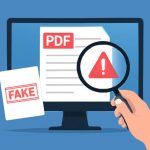
Why PDFs, Invoices and Receipts Are Common Targets for Fraud
PDFs have become the lingua franca of digital business communication because they preserve layout, embed fonts, and are easy to share. Those same qualities make them attractive to fraudsters: a single manipulated file can impersonate a supplier, falsify a payment request, or create a counterfeit receipt that looks identical to a legitimate one. Understanding the motivators and mechanics behind these attacks is the first step to defense.
Attackers exploit a range of weaknesses. Simple visual edits — swapped logos, altered totals, or changed bank details — can deceive busy staff. More sophisticated fraud uses metadata manipulation, embedded scripts, or layered objects so the visible text doesn't match underlying data. Because PDFs can contain images, text layers, form fields, and attachments, a single forged document can hide multiple anomalies. That’s why training alone is insufficient; procedural controls and technical checks are essential.
Recognizing common red flags helps reduce exposure. Unexpected requests for rapid payment, changed vendor account numbers, or invoices that don’t match purchase orders should trigger verification. Visual clues like inconsistent fonts, blurry logos, or odd spacing are signs to probe deeper. Using detect fraud in pdf practices — combining manual scrutiny with automated validation — dramatically lowers the chance of falling for impersonation or payment diversion schemes.
Technical Methods to Detect PDF and Invoice Fraud
Technical analysis of a PDF reveals layers of information invisible to the naked eye. Start with metadata: creation dates, modification timestamps, author fields, and software identifiers often betray tampering. A file that claims to be created months ago but was modified yesterday, or that lists consumer PDF software instead of enterprise tools, warrants suspicion. Hashing integrity checks and checksum comparison against original records provide strong evidence of alteration.
Digital signatures and certificate-based signing are among the most reliable defenses. Signed PDFs include cryptographic signatures that bind the content to a signer; if any content changes, the signature breaks. Verifying signatures against trusted certificate authorities prevents acceptance of forged approvals. For unsigned files, extract the text with OCR to compare machine-readable content against the visible image — discrepancies are common in forged receipts and invoices.
Automated tools that parse PDF structure can surface hidden layers, embedded fonts, and suspicious scripts. Machine-learning classifiers trained on legitimate invoices and receipts detect unusual patterns in layout, wording, or amounts. To streamline this, many teams integrate third-party services; for example, using solutions like detect fake invoice can automate checks for altered amounts, mismatched vendor details, or anomalous metadata, reducing manual review time and improving detection rates.
Case Studies, Practical Checks, and Organizational Controls
Case: A mid-sized retailer received an invoice that appeared identical to a long-time vendor’s billing. Visual inspection passed, but a metadata audit showed the file had been created on a weekend and by an unfamiliar author. Cross-checking bank details with the vendor’s records revealed a changed account — a classic payment diversion attempt. Because the company required dual verification for vendor changes, the fraud was caught before any funds transferred.
Practice-focused checks that organizations should adopt include: enforcing multi-factor verification for supplier bank changes, keeping a single source of truth for vendor master data, and requiring cryptographic signatures for high-value invoices. Operational controls — such as a mandatory hold on first-time payments to new accounts and parallel confirmations via known phone numbers — close common social-engineering vectors that accompany forged documents.
Real-world detection also leverages layered technical controls. Regularly scanning document repositories to flag anomalies, using OCR to validate that textual content matches scanned images, and performing font and layout analysis expose subtle forgeries. Training staff to recognize common fraud indicators, coupled with automated checks that highlight discrepancies, forms a robust defense. Organizations that combine policy, people, and technology reduce loss, preserve supplier trust, and make it much harder for attackers to succeed at scale.