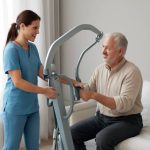
The repetitive motion of assisting a patient from a seated to a standing position remains one of the most physically demanding tasks in healthcare and home care. Manual transfers place immense strain on the lumbar spine, often forcing caregivers to bear significant loads while the patient is unbalanced. While full-body sling lifts serve patients who are completely dependent, the electric sit to stand lift occupies a unique clinical niche. It is designed specifically for individuals who possess the ability to bear weight and participate actively in their own transfer. By leveraging an electric motor to manage the vertical lifting arc, these devices eliminate the dangerous biomechanical load on the caregiver while simultaneously preserving the patient's standing function. This equipment bridges the gap between dependent mobility and complete independence, making it a critical tool for reducing workplace injuries, improving patient dignity, and streamlining daily care workflows.
How an Electric Sit to Stand Lift Reshapes Caregiver Safety and Workflow
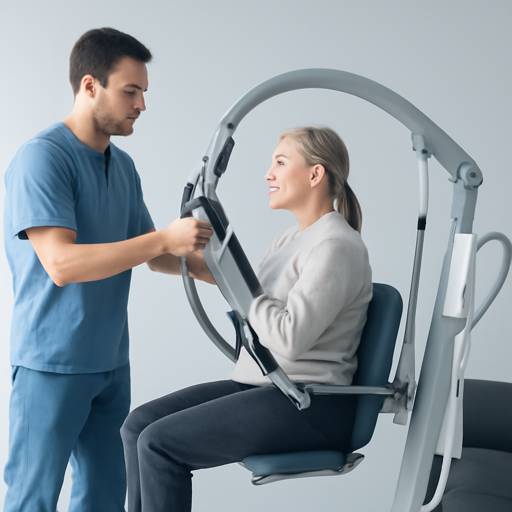
The primary value of an electric sit to stand lift lies in its ability to fundamentally alter the physics of a patient transfer. In a manual assisted stand, the caregiver typically must squat, reach forward, and bear the patient’s weight while pivoting. This motion generates high compression and shear forces on the caregiver's lower back, specifically the L5/S1 disc. An electric sit to stand lift replaces this human counterbalance system with a mechanical one. The device uses a battery-powered actuator to smoothly lift the patient from a seated position, while the patient holds onto stable handles and stands on a low platform. The caregiver’s role shifts from weight-bearer to coordinator, managing the sling placement and guiding the movement without ever absorbing the patient's gravitational load.
For healthcare administrators evaluating capital equipment purchases, investing in a high-quality electric sit to stand lift represents a direct investment in workforce longevity. Data from occupational health studies consistently show that consistent use of these devices reduces the incidence of musculoskeletal injuries by a significant margin compared to manual techniques. The workflow improvements are equally substantial. A transfer that traditionally requires two or three staff members using a manual assist can often be performed safely by a single caregiver using the lift. This frees up skilled nursing staff to focus on clinical tasks rather than physical labor. The electric motor operates quietly and smoothly, which reduces patient anxiety and improves cooperation. Furthermore, modern models feature wide-opening base legs and low-profile footplates that easily accommodate wheelchairs and commodes, enabling efficient transfers directly from the bedside to the bathroom or chair without complex repositioning. The integration of digital weight scales into some models adds another layer of clinical utility, allowing for easy daily weight monitoring during the transfer process itself.
Clinical Applications and Patient Selection for Partial Weight-Bearing Transfers
Selecting the appropriate patient for an electric sit to stand lift is crucial for both safety and efficacy. The ideal candidate is a patient who can bear weight through their lower extremities and has some trunk control, but lacks the strength or balance to stand independently. Common clinical populations include orthopedic patients recovering from total hip or knee arthroplasty, individuals with neuromuscular conditions such as Parkinson’s disease or multiple sclerosis, and frail elderly patients experiencing general deconditioning. For these individuals, the lift provides a consistent, controlled assist that matches their level of ability. It does not enforce a passive lift; rather, it encourages active participation. The patient pushes through their legs and uses their core muscles, which is vital for maintaining muscle mass and promoting neuromuscular re-education during rehabilitation.
However, proper assessment and contraindications must be clearly understood. Patients who are non-weight bearing, such as those with lower extremity fractures or certain post-operative restrictions, are not candidates for this type of lift. Similarly, individuals with severe cognitive impairment who cannot follow simple commands or who lack sufficient trunk and head control may be at risk of falling forward or experiencing respiratory distress during the transfer. The sling placement is also a critical clinical skill. The sling is positioned behind the back and under the arms, supporting the torso without restricting the patient’s ability to stand. The knee pad provides a physical cue and stabilizing point. Clinicians must also consider the patient’s ability to grip the handles. Integrating the electric sit to stand lift into a broader mobility protocol often enhances patient outcomes. For instance, using the device to facilitate early mobilization in a post-surgical patient can reduce length of stay, prevent pressure injuries, and improve respiratory function, all while ensuring that the patient remains an active participant in their own recovery journey.
Evolution of Mobility: Real-World Outcomes and Clinical Data
The practical benefits of the electric sit to stand lift are best understood through concrete clinical examples and outcome data. Consider a 150-bed skilled nursing facility that transitioned from a policy of manual two-person assists to a mandatory sit-to-stand protocol for all qualifying residents. Within twelve months, the facility reported a 45% reduction in staff lost workdays due to back injuries. The financial impact was significant, with a measurable drop in workers' compensation claims and a notable improvement in staff retention. Caregivers reported feeling more confident and less physically drained at the end of their shifts, which directly correlates with the reduction of cumulative trauma associated with repetitive manual transfers.
A second case involves a 78-year-old male with progressive Parkinson’s disease living at home with his spouse. The spouse, a 65-year-old woman weighing considerably less than her husband, was at high risk of injury during daily transfers. Prior to acquiring the lift, the couple relied on cumbersome manual pivots that were unstable and exhausting. After implementing a mobile electric sit to stand lift into their routine, the spouse was able to perform safe transfers independently. The patient retained his ability to stand and walk short distances with a walker, as the lift did not foster dependence. This scenario highlights a critical benefit: the electric sit to stand lift can enable patients to remain in their homes longer, delaying the need for institutional care. The device supported the patient’s autonomy by allowing him to use his existing strength safely, while providing the caregiver with the mechanical leverage needed to prevent injury. These outcomes illustrate that the lift is not merely a transfer device; it is a mobility tool that preserves function, enhances safety, and supports the human connection between caregiver and patient by removing the fear and strain of the physical act of lifting.